What is Audience Segmentation?
Every performing arts organization knows that it’s not enough to simply produce great art: marketing your productions and engaging your patrons is a critical part of running your organization. In an era of reduced attendance, fewer return patrons, and rising costs, it’s never been more difficult for performing arts organizations to reach audiences and sell tickets.
With traditional forms of marketing, such as show posters, local media, and word of mouth, you’re casting a wide net and hoping that it reaches the right people. While there is value in that type of marketing, and it should remain a part of your overall strategy, performing arts organizations now have access to new tools to reach patrons more effectively online using audience segmentation.
Audience segmentation is a marketing practice that involves dividing a target audience into smaller groups based on shared characteristics, with the goal of delivering those groups more personalized messaging that will lead to stronger connections and improved engagement.
Most importantly, it works: dozens of independent studies across multiple industries show that strategically marketing to segmented audiences consistently leads to more repeat customers and higher sales. In fact, LinkedIn reports that 80% of organizations that use audience segmentation report increased sales.
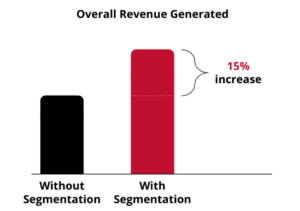
Source: Business News Daily
That’s why On The Stage (OTS) has released a new suite of audience segmentation tools that make it fast and easy to reach targeted audiences based on their past OTS purchase and attendance behaviors. These segments can be automatically created in seconds using only a few clicks, and they update dynamically over time as a patron’s behavior changes - meaning you never need to worry about a segment being out of date. Best of all, once you’ve created an OTS audience segment, you can use it to reach your audience wherever they are using additional tools like Mailchimp, Meta*, and Google*.
Uses for Audience Segmentation
Let’s say you’re coming off of a great season using OTS as your ticketing platform. All that time, OTS wasn’t just making it easy to sell tickets, manage your box office, and delight your patrons - it was also securely capturing information about your patrons, such as how many shows they attended, how many tickets they purchased, if they made donations, and more. Using that data, OTS can automatically create audience segments based on a shared set of attributes, such as:
- Patrons who attended two or more shows
- Patrons who made a donation
- Patrons who purchased a subscription package
- Patrons who haven’t attended a show in the last six months
…and so much more. Using these examples, it’s easy to see how you might create targeted email and social campaigns to reach those patrons with messaging and special offers that pertain directly to them, such as:
- Patrons who attended two or more shows: Thank them for their support, tease your upcoming season, give them early access to buy tickets, and offer promo codes and discounts
- Patrons who made a donation: Thank them for their donation, and offer them more ways to give
- Patrons who purchased a subscription package: Tease your upcoming season and subscription packages, and offer them early access and discounts
- Patrons who haven’t attended a show in the last six months: Let them know that you miss them, and provide them with special deals and offers to try to increase their engagement in the coming season
Using audience segments, the opportunity to subdivide your audience and create tailored campaigns designed to resonate with them is endless. And as we’ve said, they work - targeted emails consistently outperform general outreach such as blanket newsletters.
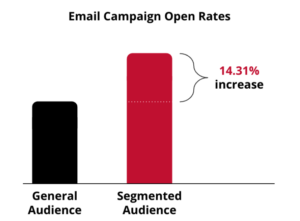
Source: BDO
Creating Audience Segments with OTS
Let’s say you want to create a segment of patrons who have donated to your organization within the last twelve months. The first step is to create your segment in the new Patron Segmentation dashboard.
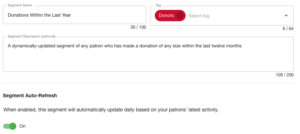
Here, you can give your segment a name, apply any number of custom tags you’ve defined, and give the segment an optional description. You also have the option to choose if the segment automatically refreshes over time or not. In this case, by selecting auto-refresh, the segment will automatically update to always look back twelve months from the current date.
The next step is to create a rule, which is used to identify what patron data will be used to define the segment.
Once you’ve created your rule, you can define it simply using three parts: an attribute, an operator, and a value.
- The attribute is the patron behavior you want to use to build the segment - in this case, patrons who have made a donation.
- The operator defines which patrons will and will not be included in the segment, which in this case is “in the last.”
- Finally, the value is the number of months, or twelve.
For a complete list of available attributes and operators, scroll down.

You’ll notice that as you define your rule, the dropdowns for “operator” and “value” automatically update as you go to dynamically present you with only the options that are relevant to what you’re doing. This is designed to make the creation process as easy and intuitive as possible.
When defining your rule, OTS will also automatically display the number of patrons in the segment you’re defining. Segments perform best when targeted enough to be meaningful, while remaining large enough to reach a sizable audience. The segment size preview bar lets you instantly understand the size of your proposed segment in real-time, which helps you to build segments that are in the sweet spot.
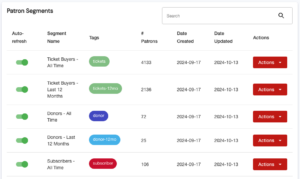
Finally, you can choose if you want the segment only to live within OTS and be used with our native marketing tools, or if you want to automatically “push” them to a third-party platform, such as Meta, Google, or Mailchimp.

By using your segment on one or all of those platforms, you are instantly able to reach those same patrons on those platforms, which drastically increases your ability to reach them where they are.
That’s it! Simply click “create,” and your audience segment is ready to use.
Building Advanced Segments
Using that same basic methodology, OTS also enables you to create even more advanced audience segments by combining multiple rules at the same time. For example, let’s say you wanted to create a segment of patrons who have attended a show within the last three years, but haven’t been back in the last twelve months. This is easy to accomplish by simply combining two rules within the same segment:
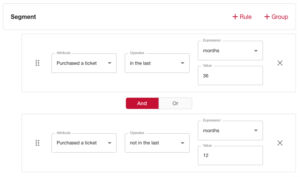
By using “and” and “or” relationships, you can see how easy it is to create powerful rules to target niche audiences based on their past purchase and attendance behaviors.
You can even go a step further by grouping several rules together (intuitively called a “group”), and combining them with other rules or groups. For example, perhaps you want to target previous patrons who haven’t bought a ticket in the last twelve months, and have only ever attended one of your productions. That’s easy to accomplish using groups:
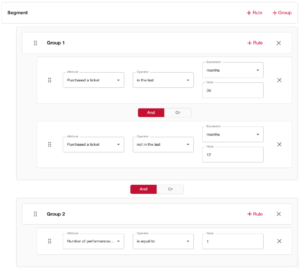
It’s easy to see the possibilities to quickly create high-quality audience segments, and how you might develop messaging, promotions, and campaigns to reach those patrons both within and outside of OTS. And with the ability to create an unlimited number of audience segments, the possibilities are limitless.
Data Available for Audience Segments
OTS automatically and dynamically uses patrons’ past purchase and attendance data to build audience segments, making them fast and easy to create without having to manually sift through spreadsheets of patron data. Here’s a complete list of what you can do with audience segments:
Attributes
Our platform supports a number of attributes regarding donations, ticket purchases, subscriptions, add-on purchases, order details, and attendance history.
Whether you're looking to bring back repeat donors or thank your highest donors, segmenting by donations allows you to drill down within those audiences. Donation segments include:
- Has ever made a donation
- Last donation made
- Amount donated
- Overall number of donations
Segmenting by ticket purchases is helpful when trying to re-engage specific patrons, build out a loyalty program, or offer exclusive promotions. Ticket segments include:
- Has ever purchased a ticket
- Last tickets purchased
- Overall number of tickets purchased
Building out a new subscriptions strategy? Looking to retain your existing subscribers? With this release, you have access to the following subscription segments:
- Has ever purchased a subscription
- Last subscription purchased
- Overall number of subscriptions purchased
Add-ons can provide an extra layer of engagement with your audience, from concessions to exclusive experiences. Whether you’re focused on boosting add-on sales or rewarding frequent buyers, you can segment patrons based on their history of purchasing add-ons. Add-on segments include:
- Has ever purchased an add-on
- Last add-on purchased
- Overall number of add-ons purchased
- Total amount spent on add-ons
Understanding overall order patterns can help you identify your most valuable patrons and tailor special offers to them. Segmenting by order details enables you to look at the full picture of their purchases. Segments around order details include:
- Has ever placed an order
- Last order placed
- Overall number of orders
- Amount spent per order
Keeping track of attendance patterns is key to boosting audience loyalty and engagement. Whether you're recognizing long-time attendees or enticing those who haven’t come in a while, you can segment your audience based on their attendance history. The available attendance segments include:
- Has ever attended a performance
- Last performance attended
- Total number of performances attended
Operators
Once you've segmented your audience by the criteria above, OTS also allows you to filter data using various operators. This ensures precision when targeting specific audience segments, such as frequent attendees or high-value donors. Operators include:
- Numbers: Is equal to, Is not equal to, Is greater than or equal to, Is less than or equal to, Is greater than, Is less than, Is in the range
- Dates: On, Not on, After, Before, Not after, Not before, In the date range, In the last, In the next, Not in the last
- Value: Custom filters like a date, dollar amount, number, or text (e.g., a show title)
How to Get Started
By using OTS audience segments, it’s easier than ever for your performing arts organizations to reach the patrons you need quickly and with ease. OTS platinum customers can get started today by logging in to the platform and navigating to “patron segmentation” in the navigation bar.
To learn more about patron segments and how they can help you increase sales and boost engagement, talk to your OTS account manager or schedule a demo today.
*Coming Soon